
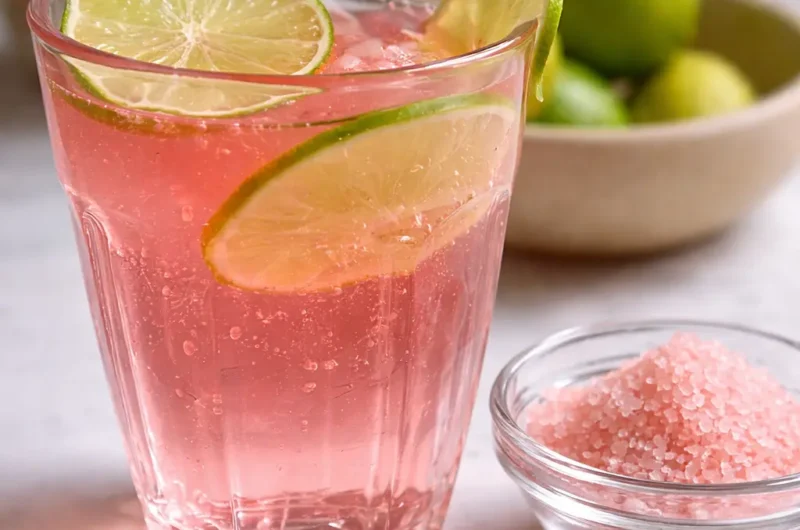
Pink Salt Recipe Ingredients (Exact Composition Breakdown)
Pink salt recipe ingredients primarily consist of sodium chloride (about 97–99%), along with trace minerals such as iron, magnesium, potassium, and calcium. Despite its pink color and marketing claims, sodium remains the dominant component.
When people search for pink salt recipe ingredients, they are usually asking one of two things:
- What is actually inside Himalayan pink salt?
- How is it different from regular table salt?
Before discussing drinks or cooking uses, the foundation matters. Understanding the true composition of pink salt recipe ingredients prevents confusion around mineral claims and health assumptions.
For a full evidence-based overview of how pink salt fits into hydration and weight discussions, see our complete pink salt weight loss guide.
The Core Ingredient: Sodium Chloride
The main ingredient in pink salt recipe ingredients is sodium chloride — the same compound found in regular table salt.
On average:
- 97–99% of Himalayan pink salt is sodium chloride.
- The remaining portion consists of trace minerals in very small quantities.
This percentage is supported by nutrient databases such as USDA FoodData Central, which show sodium as the primary component.
That means the mineral differences are measurable — but not dominant.
Why Pink Salt Is Pink
The pink color in pink salt recipe ingredients comes from trace amounts of:
- Iron oxide (the primary contributor to color)
- Magnesium
- Potassium
- Calcium
These minerals exist in small concentrations, but iron gives the salt its recognizable hue.
The color does not indicate a high iron content — only a trace presence.
Mineral Breakdown of Pink Salt Recipe Ingredients
Below is a simplified breakdown of typical composition ranges:
| Component | Approximate Percentage | Primary Role |
|---|---|---|
| Sodium chloride | 97–99% | Fluid balance |
| Iron | Trace | Pigmentation |
| Magnesium | Trace | Electrolyte support |
| Potassium | Trace | Fluid regulation |
| Calcium | Trace | Structural mineral |
Even though multiple minerals are present, sodium remains the overwhelming majority of pink salt recipe ingredients.
Why This Composition Matters in Recipes
From a cooking perspective, this means:
- Flavor strength is comparable to regular salt
- Mineral flavor differences are subtle
- Sodium impact is similar per teaspoon
When used in drinks or recipes, pink salt recipe ingredients function primarily as salt — not as a concentrated mineral supplement.
Understanding this helps separate culinary value from marketing claims.
Key Takeaway
Pink salt recipe ingredients are mostly sodium chloride with trace minerals responsible for color and minor flavor variation.
It is a natural salt source — but its composition is not dramatically different in sodium impact compared to other salts.
This clarity forms the foundation for everything else — whether you are cooking, seasoning, or exploring wellness uses.
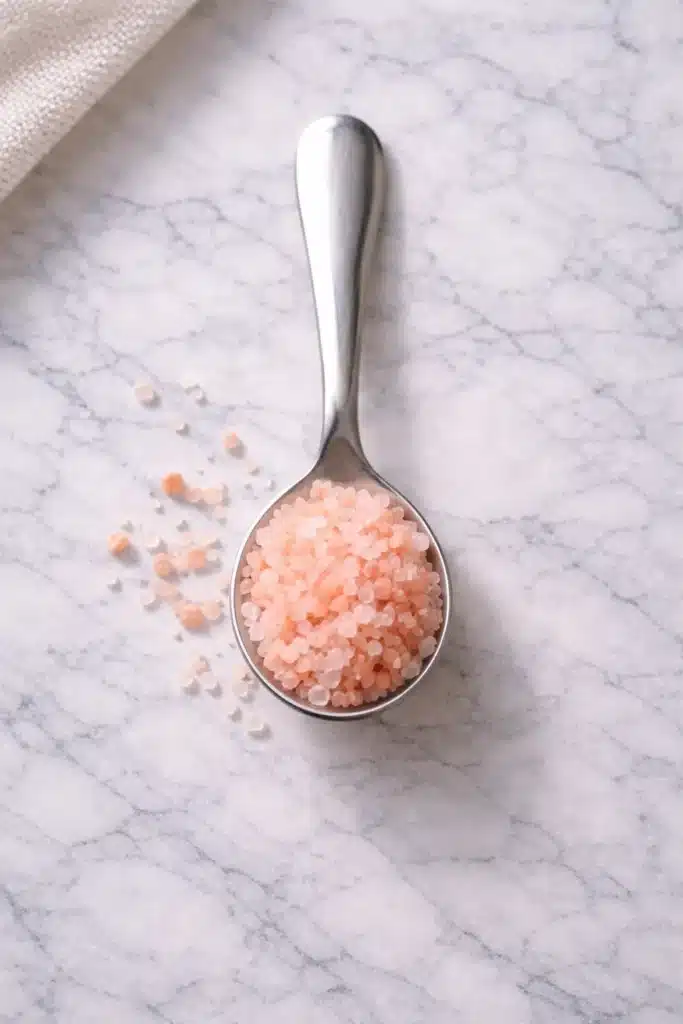
What Is the Main Ingredient of Pink Salt?
Direct Answer :
The main ingredient in pink salt recipe ingredients is sodium chloride, which typically makes up 97–99% of Himalayan pink salt. Trace minerals account for the remaining fraction.
When people search for pink salt recipe ingredients, they are usually trying to confirm what pink salt is actually made of — beyond the marketing language.
The answer is straightforward: sodium chloride.
Sodium Chloride: The Dominant Component
Sodium chloride (NaCl) forms the structural base of all salt varieties, including Himalayan pink salt.
According to USDA FoodData Central, sodium is the primary measurable nutrient in pink salt, with trace minerals present in very small quantities.
This means that from a nutritional standpoint, pink salt recipe ingredients are overwhelmingly sodium-based.
Sodium chloride determines:
- Flavor intensity
- Salinity
- Sodium content per serving
- Impact on daily intake totals
Even though the color differs, the core compound remains the same as other salts.
Why the Trace Minerals Do Not Replace Sodium
Pink salt is often marketed as mineral-rich.
It does contain trace amounts of:
- Iron
- Magnesium
- Potassium
- Calcium
However, these minerals exist in concentrations too small to meaningfully alter its sodium dominance.
The National Institutes of Health Office of Dietary Supplements explains sodium’s essential role in fluid balance and nerve function — reinforcing that sodium remains the physiologically significant component of salt.
Trace minerals contribute color and minor chemical variation — but they do not transform pink salt into a high-mineral supplement.
How This Compares to Public Health Sodium Guidance
Because sodium chloride dominates pink salt recipe ingredients, its health considerations align with standard sodium recommendations.
The Harvard T.H. Chan School of Public Health emphasizes that while sodium is required for normal physiological function, excessive intake may increase cardiovascular risk.
This reinforces an important distinction:
The type of salt does not eliminate sodium impact.
Total intake matters more than mineral marketing.
Practical Implication for Recipes
Understanding the main ingredient of pink salt recipe ingredients matters for cooking and drinks:
- A teaspoon of pink salt delivers sodium similar to table salt
- Substituting pink salt does not reduce sodium exposure
- Flavor differences are subtle rather than structural
From a culinary perspective, pink salt behaves primarily as salt — not as a concentrated mineral source.
Clear Summary
The main ingredient in pink salt recipe ingredients is sodium chloride.
Trace minerals exist, but sodium overwhelmingly defines its nutritional and culinary function.
Recognizing this distinction helps separate ingredient science from marketing language — especially when pink salt is used in recipes, drinks, or wellness routines.
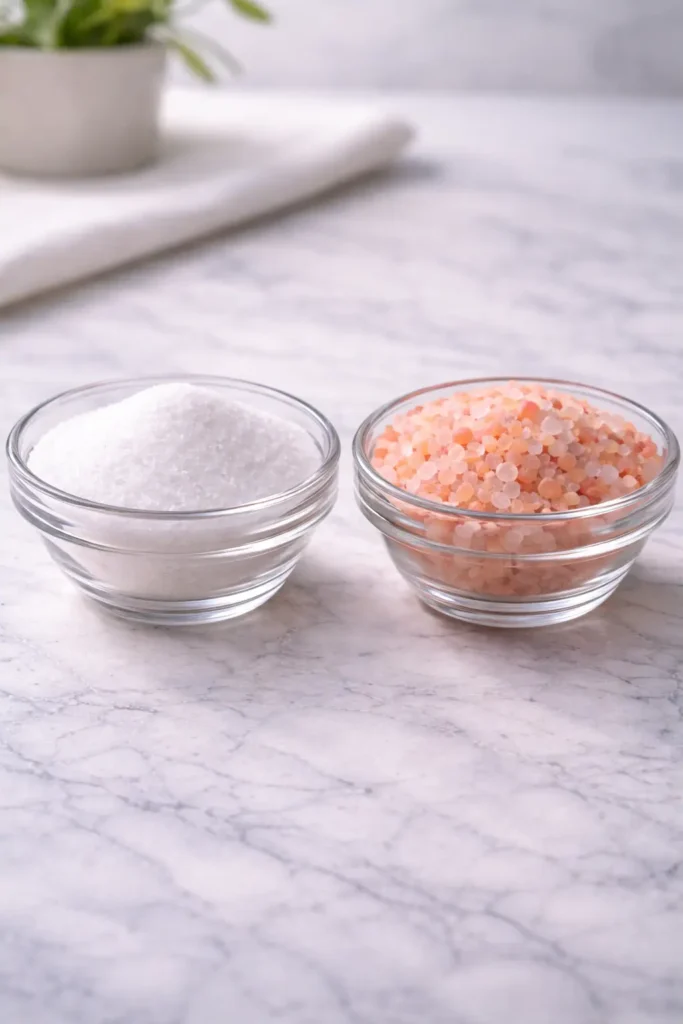
Pink Salt vs Table Salt Ingredients (What’s the Real Difference?)
Direct Comparison Summary
Pink salt recipe ingredients and table salt are both primarily composed of sodium chloride. The main differences lie in processing methods, trace mineral presence, iodine fortification, and added anti-caking agents.
When comparing pink salt recipe ingredients to table salt, the differences are often overstated. The base compound remains the same: sodium chloride.
However, there are structural and processing distinctions worth understanding.
Side-by-Side Ingredient Comparison
| Feature | Pink Salt | Table Salt |
|---|---|---|
| Main Ingredient | Sodium chloride (97–99%) | Sodium chloride (~99%) |
| Trace Minerals | Present (iron, magnesium, potassium) | Minimal |
| Iodine Added | Usually no | Often yes |
| Anti-Caking Agents | Typically none | Often included |
| Processing Level | Minimally processed | Refined & purified |
This table captures the practical ingredient-level differences clearly.
Processing Differences
Pink salt is typically mined and minimally processed, which allows trace minerals to remain in small quantities.
Table salt undergoes heavier refinement to remove impurities and standardize texture. During this process:
- Natural trace minerals are removed
- Iodine is often added
- Anti-caking agents may be included
The National Institutes of Health (NIH) explains iodine fortification as a public health measure to prevent deficiency.
This is an important nutritional distinction:
Table salt often contains added iodine; pink salt typically does not.
Sodium Content: Nearly Identical
From a sodium standpoint, pink salt recipe ingredients and table salt are comparable.
According to USDA FoodData Central, sodium remains the primary measurable nutrient in both varieties.
The mineral traces in pink salt do not meaningfully reduce sodium concentration per serving.
This means substituting pink salt does not significantly lower sodium intake.
Flavor and Culinary Impact
In recipes:
- Pink salt may have a slightly milder mineral note
- Texture can differ (coarse vs fine grind)
- Visual presentation varies
However, from a sodium perspective, both salts function similarly in cooking.
If you’re using pink salt recipe ingredients in drinks — especially for a morning hydration routine — review the exact ratios in our pink salt weight loss drink guide.
Health Framing
The Harvard T.H. Chan School of Public Health emphasizes that total sodium intake is the key dietary consideration — not salt color.
The choice between pink salt and table salt does not override recommended sodium limits.
What matters most:
✔ Total daily sodium
✔ Overall diet quality
✔ Individual health status
Clear Takeaway
Pink salt recipe ingredients differ from table salt in processing and trace mineral presence.
They do not differ significantly in sodium impact.
Understanding that distinction prevents confusion between marketing language and ingredient science.
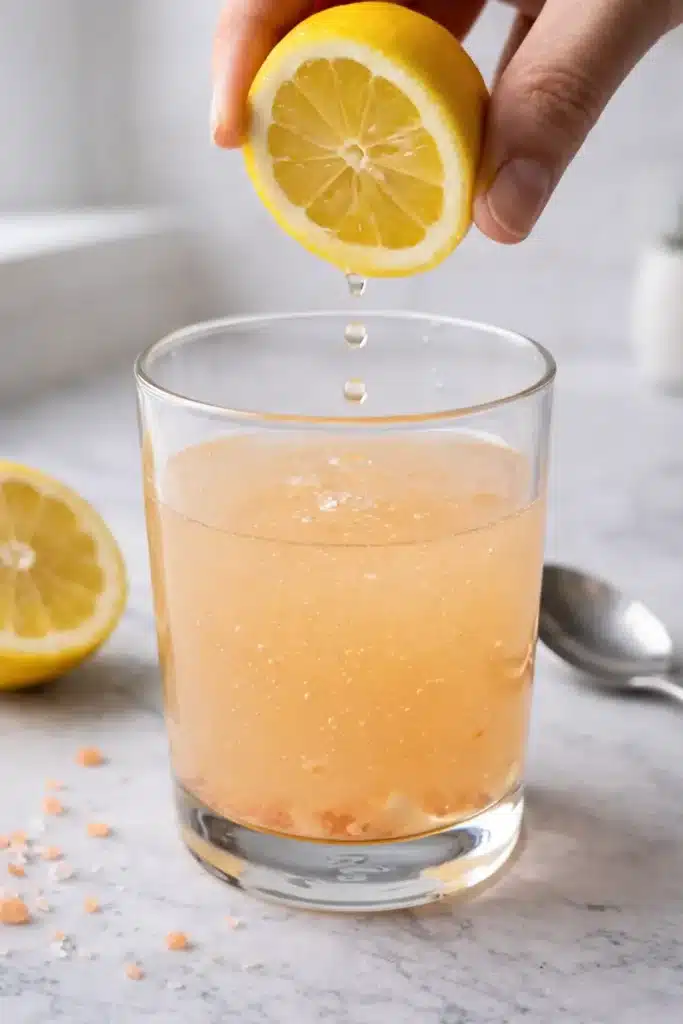
Mineral Breakdown: What the Trace Elements Actually Do
Summary :
Pink salt recipe ingredients contain trace amounts of minerals such as iron, magnesium, potassium, and calcium. These minerals contribute to color and minor chemical variation but are present in small quantities relative to daily nutritional requirements.
When discussing pink salt recipe ingredients, the mineral profile is often highlighted. While trace minerals are present, understanding their scale and function is essential.
The mineral contribution is real — but modest.
Iron (Fe)
Iron is primarily responsible for the pink or reddish hue in Himalayan salt.
In the body, iron supports:
- Oxygen transport via hemoglobin
- Cellular energy production
However, the amount of iron found in pink salt recipe ingredients is minimal compared to daily iron needs.
The National Institutes of Health (NIH) outlines iron requirements that are significantly higher than what salt can provide in culinary amounts.
Pink salt contributes color — not meaningful iron intake.
Magnesium (Mg)
Magnesium is involved in:
- Muscle function
- Nerve signaling
- Energy metabolism
The NIH Office of Dietary Supplements explains that magnesium requirements are typically met through foods such as leafy greens, nuts, and whole grains.
While magnesium appears in pink salt recipe ingredients, it is present in trace levels that do not significantly alter daily intake totals.
Potassium (K)
Potassium plays a role in:
- Fluid balance
- Muscle contraction
- Blood pressure regulation
According to Harvard T.H. Chan School of Public Health, potassium intake is most effectively supported through fruits and vegetables.
Pink salt contains only small traces of potassium relative to recommended intake levels.
Calcium (Ca)
Calcium supports:
- Bone structure
- Muscle contraction
- Nerve transmission
The National Institutes of Health outlines daily calcium needs that are far higher than what trace mineral levels in salt can provide.
In pink salt recipe ingredients, calcium is present — but not in nutritionally significant quantities per serving.
Why “Trace” Really Means Trace
The term “trace minerals” can sound substantial.
In reality, trace means:
- Present in very small amounts
- Not a primary nutrient source
- Chemically detectable, but nutritionally minor
According to USDA FoodData Central, sodium remains the dominant measurable nutrient in pink salt.
This reinforces an important conclusion:
Pink salt recipe ingredients are primarily sodium chloride with minor mineral presence.
Practical Culinary Perspective
From a cooking standpoint:
- Trace minerals may contribute subtle flavor complexity
- They influence color and texture
- They do not transform pink salt into a mineral supplement
When using pink salt recipe ingredients in recipes or drinks, the sodium content remains the primary nutritional consideration.
Clear Takeaway
Pink salt recipe ingredients contain trace minerals that contribute to appearance and minor chemical variation.
However, sodium chloride remains the dominant component, and trace minerals do not significantly impact nutritional intake at typical culinary serving sizes.
Understanding this distinction helps keep ingredient science grounded and realistic.
Pink Salt Recipe Ingredients and Weight Loss Claims (Clarified)
Summary :
Pink salt recipe ingredients do not directly cause fat loss. Their role in weight-related discussions comes from hydration behavior and beverage substitution — not metabolic acceleration.
Because pink salt recipe ingredients are often used in viral drinks like the popular pink salt trick recipe, they are frequently associated with weight loss.
It’s important to separate ingredient composition from marketing language.
Do Pink Salt Recipe Ingredients Burn Fat?
No.
Pink salt recipe ingredients are primarily sodium chloride. Sodium regulates fluid balance, not fat oxidation.
There is no established clinical evidence showing that sodium intake increases calorie burn or directly reduces body fat.
Weight loss occurs when sustained calorie intake remains lower than energy expenditure.
Salt does not alter that biological principle.
Why Do Some People Report Weight Changes?
When pink salt recipe ingredients are used in diluted morning drinks, three behavioral shifts may occur:
- Improved hydration upon waking
- Reduced reliance on high-calorie beverages
- Structured morning routine
Replacing sweetened coffee drinks or juices with water-based beverages can reduce daily calorie intake.
The change is behavioral — not chemical.
For context on hydration and sodium function, the Harvard T.H. Chan School of Public Health explains sodium’s role in fluid regulation:
Fluid regulation supports normal physiology. It does not trigger fat burning.
Do Trace Minerals Influence Metabolism?
Pink salt recipe ingredients contain small amounts of minerals such as iron and magnesium.
However, according to USDA FoodData Central, sodium remains the dominant measurable nutrient:
Trace minerals are present in very small quantities relative to daily nutritional requirements.
There is no strong evidence showing that these trace levels significantly affect metabolic rate.
What the Research Does Not Show
There is currently no high-quality clinical research demonstrating that pink salt recipe ingredients:
✘ Increase resting metabolic rate
✘ Target belly fat
✘ Detox stored fat
✘ Suppress appetite chemically
Claims suggesting otherwise are not supported by established nutrition science.
For sodium intake guidance and cardiovascular context, see the American Heart Association:
Where the Confusion Comes From
Hydration changes can temporarily shift:
Water retention
Bloating perception
Appetite timing
Short-term water fluctuations are often mistaken for fat loss.
The pink salt recipe ingredients themselves are not altering body fat stores.
Practical, Evidence-Based Perspective
Pink salt recipe ingredients may:
✔ Support hydration routines
✔ Replace higher-calorie beverages
✔ Encourage structured eating patterns
They do not:
✘ Act as fat-burning compounds
✘ Replace energy balance principles
✘ Function as metabolic enhancers
If your interest began through viral trends, start with our evidence-based pink salt weight loss guide for a broader scientific perspective.
Clear Takeaway
Pink salt recipe ingredients are culinary components.
Their impact on weight is indirect and behavioral, not biochemical.
Understanding that distinction prevents unrealistic expectations — and strengthens long-term credibility.
Ingredient Variations and Substitutions
Summary :
Pink salt recipe ingredients can be adjusted based on availability. While Himalayan pink salt is commonly used, sea salt or table salt can function similarly in most recipes. The primary difference is trace mineral content and texture — not sodium structure.
When discussing pink salt recipe ingredients, it’s important to understand that the dominant compound remains sodium chloride.
Substitutions are therefore possible — with some considerations.
1. Can You Replace Pink Salt With Table Salt?
Yes.
Table salt is also primarily sodium chloride. The key differences are:
- Table salt is more finely ground
- It may contain anti-caking agents
- It is often iodized
Nutritionally, sodium content remains comparable by weight.
According to USDA FoodData Central, sodium levels are similar across most salt types when measured gram-for-gram:
The substitution ratio is typically 1:1 by weight.
Because table salt is finer, you may need slightly less by volume.
2. Can You Use Sea Salt Instead?
Yes.
Sea salt and Himalayan pink salt share similar structural composition.
Differences include:
- Mineral trace variation
- Crystal size
- Flavor nuance
From a recipe standpoint, pink salt recipe ingredients can be swapped with sea salt without significant functional changes.
The sodium impact remains the same.
3. What About Kosher Salt?
Kosher salt is:
- Less dense
- Flake-textured
- Easier to pinch-measure
Because crystal size differs, volume measurements vary.
If replacing pink salt recipe ingredients with kosher salt, adjust slightly and taste gradually.
4. Are There “Healthier” Alternatives?
Marketing often promotes:
- Celtic sea salt
- Himalayan salt
- Mineral-rich specialty salts
However, according to the American Heart Association, cardiovascular risk relates to total sodium intake — not salt color:
No salt type eliminates sodium’s physiological impact.
The most important factor remains moderation.
5. When Substitution Is Not Ideal
Substitutions may affect:
- Visual presentation (pink color disappears)
- Coarse finishing texture
- Recipe aesthetic
For decorative or finishing applications, pink salt’s visual appeal may be part of the purpose.
Functionally, however, sodium chloride remains the working compound.
Practical Takeaway
Pink salt recipe ingredients are flexible in most culinary applications.
You can substitute:
✔ Table salt
✔ Sea salt
✔ Kosher salt
But always adjust for crystal size and monitor total sodium intake.
The ingredient identity changes slightly.
The chemistry does not.
Safety Notes and Considerations
Summary :
Pink salt recipe ingredients are primarily sodium chloride. While small culinary amounts may fit within general intake guidelines, excessive sodium consumption increases cardiovascular risk. Total daily intake matters more than salt type.
Any discussion of pink salt recipe ingredients must include safety context.
Pink Himalayan salt is often marketed as “natural” or “mineral-rich,” but nutritionally it remains predominantly sodium.
1. Sodium Intake Recommendations
According to the American Heart Association, most adults should aim to limit sodium intake to no more than 2,300 mg per day — and ideally closer to 1,500 mg for optimal cardiovascular health:
Because pink salt recipe ingredients are largely sodium chloride, they contribute to this total just like table salt.
Color does not reduce sodium load.
2. Cardiovascular Considerations
High sodium intake is associated with:
- Elevated blood pressure
- Increased cardiovascular strain
- Fluid retention
The Harvard T.H. Chan School of Public Health explains sodium’s role in fluid regulation and blood pressure balance.
When using pink salt recipe ingredients in drinks or recipes, it is important to account for sodium already present in processed foods.
Stacking multiple sodium sources increases risk.
3. Who Should Use Caution
Individuals who should approach salt-based recipes carefully include:
- Those with hypertension
- People with kidney disease
- Individuals on sodium-restricted diets
- Those prone to fluid retention
If there is any medical condition involving fluid or blood pressure regulation, consultation with a healthcare professional is advisable.
Pink salt does not bypass physiological sodium effects.
4. Common Mistake: “Natural” Equals Unlimited
A frequent misconception is that because pink salt is minimally processed, it can be used freely.
However:
- Sodium impact depends on quantity
- The body does not differentiate salt color
- Excess remains excess
Pink salt recipe ingredients should be measured — not estimated.
5. Concentrated Preparations Require Extra Caution
Some preparations, such as saturated brines (sole water), begin at much higher salt concentration.
Dilution must be precise.
Unmeasured concentrated salt solutions significantly increase sodium intake beyond casual culinary levels.
Moderation is essential.
Practical Safety Framework
If using pink salt recipe ingredients in drinks or recipes:
✔ Measure precisely (avoid “heavy pinches”)
✔ Track total sodium intake across meals
✔ Avoid combining with highly processed foods
✔ Discontinue if experiencing swelling or elevated blood pressure
Avoid:
✘ Assuming pink salt is sodium-free
✘ Using concentrated brine without understanding dosage
✘ Increasing intake based on marketing claims
Clear Takeaway
Pink salt recipe ingredients are safe in moderate culinary use for most healthy adults.
They are not risk-free when overused.
Sodium load — not mineral branding — determines safety.
Responsible usage protects both health and credibility.
Where Himalayan Pink Salt Is Commonly Available in the U.S.
Summary :
Pink salt recipe ingredients are widely available in U.S. grocery stores, natural food retailers, warehouse clubs, and online marketplaces. Availability includes fine, coarse, and grinder formats.
If you’re building recipes using pink salt recipe ingredients, sourcing is generally straightforward.
Himalayan pink salt is now considered a mainstream grocery item — not a specialty ingredient.
1. Major Grocery Chains
Most national grocery chains carry pink salt in at least one format:
- Fine-grain table salt style
- Coarse crystals
- Grinder bottles
It is typically found in:
- The spice aisle
- The baking section
- The natural foods section
Look for labeling that specifies:
“Himalayan pink salt”
“Pink Himalayan crystal salt”
“Coarse pink salt”
2. Natural & Specialty Food Stores
Retailers focused on organic and natural products often stock:
- Larger crystal sizes
- Bulk bin options
- Glass grinder packaging
These stores may emphasize mineral origin and sourcing transparency.
However, from a nutritional standpoint, pink salt recipe ingredients remain primarily sodium chloride regardless of retail setting.
3. Warehouse Clubs
Bulk retailers frequently sell:
- Large bags of coarse pink salt
- Multi-pack grinder sets
- Value-size containers
These options are cost-effective for frequent culinary use.
Be mindful of portion control when buying larger quantities.
4. Online Marketplaces
Online retailers offer:
- Fine, coarse, and flake versions
- Food-grade certified salt
- Specialty harvest claims
When purchasing online:
✔ Verify food-grade labeling
✔ Check for ingredient purity (100% salt)
✔ Avoid flavored blends if your goal is basic pink salt recipe ingredients
5. Common Forms Available
You will typically see pink salt sold as:
| Format | Best For |
|---|---|
| Fine grain | Baking, drink mixes |
| Coarse crystals | Cooking, finishing |
| Grinder bottle | Table use |
| Large chunks | Decorative / salt blocks |
The choice depends on intended use, not nutritional difference.
What to Check on the Label
When purchasing pink salt recipe ingredients, review:
- Ingredient list (should list only salt)
- Country of origin (often Pakistan)
- Additives (avoid anti-caking agents if purity matters to you)
Mineral marketing claims do not change sodium content.
Price Expectation
Pink salt is typically:
- More expensive than standard table salt
- Comparable to premium sea salts
The cost reflects mining, branding, and packaging — not a significant nutritional upgrade.
Practical Takeaway
Pink salt recipe ingredients are widely accessible across the U.S.
Availability is not the limiting factor.
Moderation and understanding sodium content remain the more important considerations.
Pink Salt Recipe Ingredients & Equipment
Quick List (Optimized)
Basic pink salt recipe ingredients include:
• Himalayan pink salt
• Filtered water
Optional additions: lemon juice, apple cider vinegar
Equipment: measuring spoon, glass, stirring utensil
When preparing recipes using pink salt recipe ingredients — especially drink variations — simplicity is key.
This is not a complex culinary formula. The base components are minimal.
Core Pink Salt Recipe Ingredients (Exact List)
The foundation includes:
- Himalayan Pink Salt
Fine or coarse grain. The primary component is sodium chloride. - Filtered Water
Warm or room temperature, depending on preference.
That is the core structure.
Everything else is optional.
Optional Additions (Common Variations)
Some recipes include:
- Fresh lemon juice
- Apple cider vinegar
- Raw honey (small amount)
- Cayenne pepper (for flavor)
These ingredients are not required for pink salt recipe ingredients themselves — they are additions for taste or ritual preference.
They do not alter the sodium foundation.
Equipment Needed
You do not need specialized tools.
Basic equipment includes:
- 1 measuring spoon (⅛ teaspoon recommended for accuracy)
- 1 glass (8–12 oz capacity)
- 1 stirring spoon
For more concentrated preparations (such as brine solutions), you may need:
- Glass jar with lid
- Non-metal stirring utensil
- Accurate measuring scale
Precision matters more than complexity.
Why Measurement Is Important
Pink salt recipe ingredients are simple — but sodium intake adds up quickly.
A “heavy pinch” may double intended sodium levels.
Using a measuring spoon ensures:
✔ Consistent preparation
✔ Controlled sodium intake
✔ Replicable results
Especially for drink-based recipes, measurement protects safety and accuracy.
Fine vs Coarse Salt for Drinks
If using pink salt recipe ingredients in beverages:
- Fine grain dissolves faster
- Coarse crystals require more stirring
- Grinder salt should be measured, not shaken freely
The difference is texture — not chemistry.
Minimalist Principle
The most accurate pink salt recipe ingredients list contains:
Salt + water.
All other additions are optional enhancements.
Simplicity improves control.
Clear Takeaway
Pink salt recipe ingredients require minimal equipment and few components.
The most important tool is measurement.
Sodium content — not ingredient complexity — determines the health impact.
How to Make the Pink Salt Drink (Step-by-Step)
Quick Ratio (Snippet Optimized)
• 8–12 oz warm filtered water
• ⅛ teaspoon Himalayan pink salt
Stir until fully dissolved. Drink immediately.
When using pink salt recipe ingredients for a basic hydration drink, precision matters more than complexity.
This is the most commonly referenced preparation method.
Step 1: Measure the Water
Pour 8–12 ounces of filtered water into a glass.
Warm or room temperature water is typically preferred because:
- It dissolves salt more easily
- It feels gentler first thing in the morning
Cold water is acceptable, but dissolution may take longer.
Step 2: Measure the Pink Salt
Add ⅛ teaspoon of Himalayan pink salt.
This amount typically provides roughly 150–200 mg of sodium, depending on crystal density.
Do not estimate by eye.
Accurate measurement ensures pink salt recipe ingredients remain within reasonable sodium ranges.
Step 3: Stir Thoroughly
Stir until the salt fully dissolves.
There should be:
- No visible crystals
- No residue at the bottom
Fine-grain salt dissolves faster than coarse crystals.
Step 4: Drink Immediately
Consume the mixture slowly.
Some people prefer:
- Morning consumption
- Pre-coffee hydration
- During fasting windows
The timing affects routine consistency — not metabolic rate.
Optional Additions (Flavor Only)
If desired, you may add:
- ½ teaspoon fresh lemon juice
- A few drops of apple cider vinegar
These do not change the core pink salt recipe ingredients — they alter flavor profile only.
Avoid adding sweeteners if the goal is calorie control.
Important Measurement Reminder
The safety of pink salt recipe ingredients depends on:
✔ Measured amounts
✔ Total daily sodium awareness
✔ Avoiding concentration stacking
This drink is diluted.
It is not a saturated brine.
What This Drink Does (Realistic Expectation)
This preparation may:
✔ Support morning hydration
✔ Replace higher-calorie beverages
✔ Contribute to electrolyte balance
It does not:
✘ Burn fat
✘ Increase metabolism
✘ Detox stored toxins
Understanding this protects credibility.
Clear Takeaway
The basic pink salt recipe ingredients for a drink are simple:
Water + a measured pinch of salt.
Precision protects both safety and expectations.
FAQ – Pink Salt Recipe Ingredients & Related Questions
How do you make pink salt at home?
You cannot technically “make” pink Himalayan salt at home because it is mined from natural salt deposits formed over millions of years.
However, you can prepare a pink salt drink at home by mixing:
8–12 oz filtered water
⅛ teaspoon Himalayan pink salt
Stir until dissolved. Measure carefully to control sodium intake.
What is Oprah’s pink salt recipe?
There is no verified or official recipe attributed to Oprah Winfrey involving pink salt for weight loss.
Many viral claims attach celebrity names to trending drinks without confirmation. If referencing any wellness routine, always verify the source directly.
What is the main ingredient of pink salt?
The main ingredient is sodium chloride.
Pink Himalayan salt is approximately 97–99% sodium chloride, with small trace amounts of minerals like iron and magnesium that give it color.
Why avoid pink salt?
Pink salt should not necessarily be “avoided,” but it should be used in moderation.
You may need to limit intake if you:
Have high blood pressure
Have kidney disease
Follow a sodium-restricted diet
Pink salt is still sodium. Excess intake increases cardiovascular risk regardless of color.
What are the 3 ingredients plus pink salt?
In most viral drink versions, the common additions are:
Lemon juice
Apple cider vinegar
Water
Pink salt is added as the sodium source.
These ingredients influence flavor and hydration routine — not fat burning.
What is the 3 ingredient drink for weight loss?
The most common three-ingredient version includes:
Water
Pink salt
Lemon juice
Some variations replace lemon with apple cider vinegar.
Weight changes, if any, typically come from replacing higher-calorie beverages — not from the salt itself.
How did Kelly Clarkson lose weight?
Public interviews indicate Kelly Clarkson has spoken about following structured nutrition plans and medical guidance.
There is no verified evidence linking her weight loss to pink salt or salt-water drinks.
Weight changes in public figures are usually multi-factorial and often involve professional supervision.
What does water with lemon and salt do to your body?
A diluted lemon-salt water drink may:
✔ Support hydration
✔ Provide sodium for fluid balance
✔ Add acidity for taste
It does not:
✘ Burn fat
✘ Detox stored toxins
✘ Increase metabolic rate
Hydration supports normal physiology, not fat oxidation.
What happens if I drink lemon water every day for 30 days?
Daily lemon water may:
✔ Increase fluid intake
✔ Replace sugary beverages
✔ Support general hydration
Possible concerns include:
Tooth enamel erosion (due to acidity)
Gastrointestinal sensitivity in some individuals
Moderation and dilution are important.
How to make salt water to drink in the morning?
Basic preparation:
8–12 oz warm water
⅛ teaspoon pink salt
Stir until dissolved.
Avoid concentrated brine unless you understand dilution ratios.
Can you drink lemon water and Himalayan salt in the morning?
Yes, many people do.
For most healthy adults, a diluted mixture in small measured amounts may fit within sodium guidelines.
However, individuals with hypertension, kidney issues, or sodium restrictions should consult a healthcare professional before daily use.
For the regional variation that follows a similar hydration approach, see the full Japanese pink salt weight loss drink guide.
Final Perspective
Pink salt recipe ingredients are simple:
Salt + water (optional lemon).
The impact is primarily hydration-based and behavioral — not metabolic.
Clarity protects expectations.
Print
Pink Salt Recipe Ingredients: What’s Really Inside?
- Total Time: 2 minutes
- Yield: 1 serving
- Diet: Gluten Free
Description
Pink salt recipe ingredients primarily consist of sodium chloride (about 97–99%), along with trace minerals such as iron, magnesium, potassium, and calcium. Despite its pink color and marketing claims, sodium remains the dominant component.
Ingredients
- Himalayan pink salt (97–99% sodium chloride)
- Trace minerals (iron, magnesium, potassium, calcium)
- Filtered water (for drink preparations)
- Fresh lemon juice (optional)
- Apple cider vinegar (optional)
Instructions
- Measure 8–12 ounces of filtered water into a glass.
- Add ⅛ teaspoon Himalayan pink salt.
- Stir thoroughly until fully dissolved.
- Add lemon juice or apple cider vinegar if desired.
- Drink immediately and monitor total daily sodium intake.
Notes
Pink salt is primarily sodium chloride. Trace minerals contribute color and minor variation but do not significantly alter sodium impact. Use measured amounts to control total daily sodium intake and avoid excessive consumption.
- Prep Time: 2 minutes
- Cook Time: 0 minutes
- Category: Beverage
- Method: No Cook
- Cuisine: Wellness
Nutrition
- Serving Size: 1 cup
- Calories: 0
- Sugar: 0g
- Sodium: 150mg
- Fat: 0g
- Saturated Fat: 0g
- Unsaturated Fat: 0g
- Trans Fat: 0g
- Carbohydrates: 0g
- Fiber: 0g
- Protein: 0g
- Cholesterol: 0mg




Pingback: Pink Salt Weight Loss Guide(2026): Science, Safety & Results
Pingback: Pink Salt Trick Recipe (2026) – Does the Viral Drink Work?
Pingback: Pink Salt Weight Loss Drink – Viral Morning Recipe 2026